Custom Plush Toy Manufacturing: The Real 30-Day Sketch-to-Delivery Timeline (2026)
Day-by-day breakdown of how a custom plush toy goes from sketch to sealed export carton — sampling, mass production, QC, shipping, and the 5 delays that actually move your timeline.

When buyers ask 'how fast can you make a custom plush toy?' the honest answer has three parts: 30 days is achievable, 35 is more realistic, and anyone quoting 20 is either ODM-rebranding or skipping QC. This is a day-by-day breakdown of what actually happens between approving a sketch and a sealed export carton, drawn from 1,200+ projects shipped from our Shenzhen factory.
The realistic 30-day clock
A 30-day sketch-to-delivery is genuinely possible — but only on a simple-to-mid-complexity SKU, with one round of sample revisions, with materials in stock, and with an efficient air-freight leg. Add a single complication (Pantone fabric match, 3 sample rounds, mid-run BOM change, sea-freight from Shenzhen to LA) and you're looking at 35–55 days. The schedule below is the lean path; the ranges in parentheses are the typical reality.
Industry-wide benchmarks for custom plush production sit around 25–40 days from design approval, before sea freight. The Toy Association's annual production survey confirms this band. The Shenzhen-to-Long Beach sea leg adds 14–18 days; the Shenzhen-to-Hamburg leg adds 28–35 days. Air freight cuts that to 3–5 days but multiplies the per-unit shipping cost roughly 8x.
Day-by-day breakdown of a 30-day plush program
The numbers below assume a 25-cm bear-format plush with embroidered features, 1 sample round, fabric available in our warehouse, and air freight to a US port. Adjust upward for any variance.
| Stage | Days | What happens | What gates the next stage |
|---|---|---|---|
| Inquiry & brief | Day 1–2 | Buyer submits sketch, target qty, packaging requirement; factory acknowledges scope, BOM and quote draft. | Signed quote + 50% deposit |
| Design & quote refinement | Day 2–5 | In-house design team produces tech pack: 2D pattern, fabric specs, accessory list, Pantone references. | Buyer approves tech pack |
| Sampling | Day 5–12 | Pattern table cuts master pattern; sewer constructs first sample; embroidery + finishing; photo + ship sample. | Buyer approves physical sample |
| Mass production | Day 12–22 | Bulk fabric requisition; cut-and-sew lines staffed; rolling QC at three checkpoints; stuffing and finishing. | AQL inspection passed |
| QC + packing | Day 22–26 | Third-party AQL 2.5 visual / 4.0 minor inspection; polybag + hangtag; master carton labelling. | Inspection certificate issued |
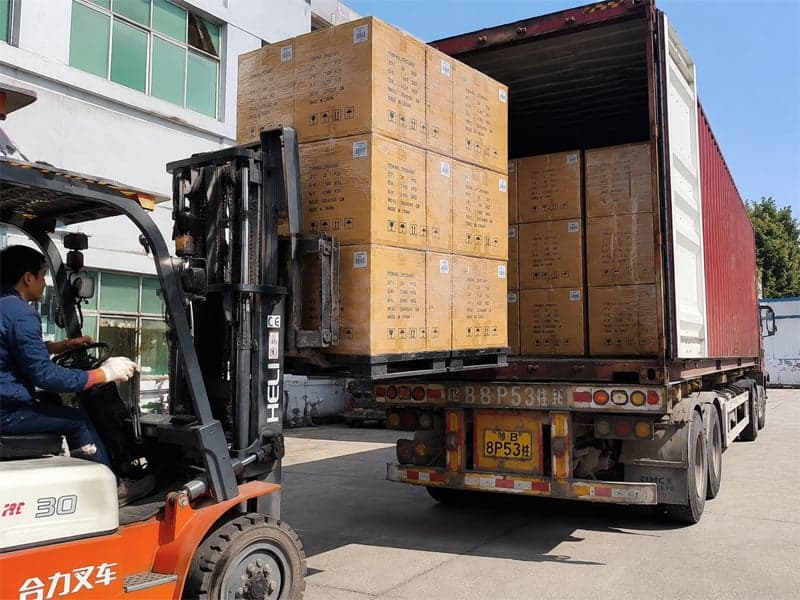
| Export & shipping | Day 26–30 | Customs filing; container loaded; air-freight handover (or sea freight booking). | Bill of Lading delivered |
The handoff diagram
Each block is a hard handoff — the next stage doesn't start until the previous one is signed off. This is what protects both sides from late-stage surprises.
- 1Inquirysketch + target qty
- 2Design + quote2-3 days
- 3Sampling7-10 days
- 4Mass production10-12 days
- 5QC + AQL3-4 days
- 6Export packing1-2 days
- 7Shippingair 3-5d / sea 14-35d
Days 1–2: Inquiry, brief, and BOM lock
The most leveraged 48 hours of the entire program. We need: the sketch (PNG/AI/PDF — anything legible), target quantity, packaging requirement (polybag or retail box), destination market (US/EU/CA changes the test list), and target landed cost. The tighter the brief, the fewer revision rounds. Vague briefs are the #1 reason 30-day programs become 45-day programs.
Days 2–5: Design, tech pack, quote
Our design team translates the sketch into a tech pack: 2D pattern with seam allowances, fabric weight + pile depth specs, accessory list (eyes, embroidery thread, satin bow), Pantone references, sewn-in label artwork, and packaging die line. The quote refresh at this stage uses the locked BOM, not the inquiry estimate — which is why the inquiry quote is non-binding.
Days 5–12: First sample
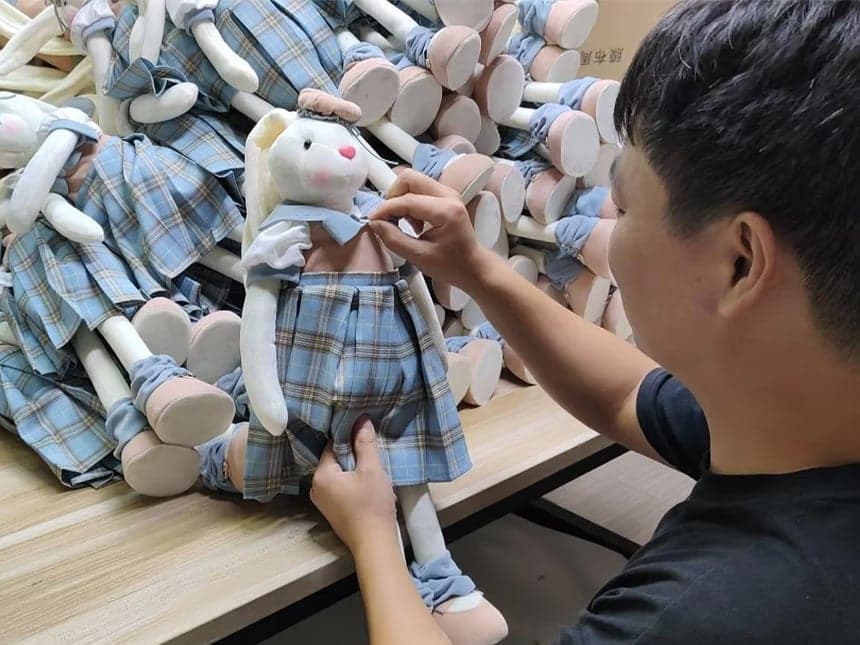
Pattern table cuts a master pattern; one of our 4 sample tailors hand-stitches the first physical sample; embroidery floor adds face details; finishing adds tag and accessories. We photograph from 6 angles and overnight a physical sample. Buyers usually request one revision round (Pantone shift, fill density tweak, eye placement) — we plan for that. Two revisions push the schedule to 35 days; three pushes to 40+.
Days 12–22: Mass production
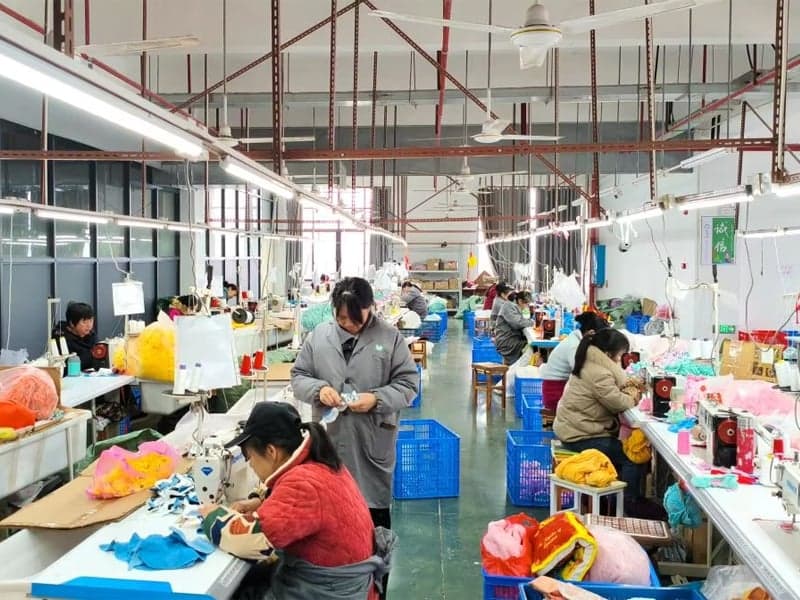
Once the sample is signed, bulk fabric is requisitioned from inventory or cut from new rolls; the cut-and-sew lines are staffed; QC inspectors run rolling checks at three checkpoints (post-cut, post-sew, post-stuff). The 10-day mass-production window assumes a 1,000-unit run on a single SKU. Multi-SKU runs share lines but add 1–2 days for changeovers.
Days 22–26: AQL inspection + retail packing
Third-party inspectors (we work with SGS, Bureau Veritas, Intertek) run AQL 2.5 visual / 4.0 minor on a randomised sample. Failed cartons are pulled and reworked. Passed cartons get polybagged with the country-specific suffocation warning, hangtagged with the buyer's brand artwork, then loaded into master cartons with shipping marks. SGS, Bureau Veritas and Intertek are the inspectors we work with.
Days 26–30: Export documents and dispatch
Customs filing, commercial invoice, packing list, country-of-origin certificate, CPC (US) or DoC (EU). Container loaded at the factory door. For air freight, the carton handover happens day 26–28; cargo arrives at destination day 28–30. For sea freight, the carton handover is the same but the timeline extends by the sea leg length.
Shipping: air vs sea vs DDP
Same factory, same carton, three very different cost / time profiles. This is the trade-off table we walk every new buyer through:
| Mode | Time (Shenzhen → US) | Cost (USD/kg, plush) | When to use |
|---|---|---|---|
| Air freight (FOB) | 3–5 days | $5.50–$8.00 | Pre-launch / sample replenishment / e-com restock |
| Sea freight LCL | 22–35 days | $0.85–$1.40 | Sub-1 CBM consolidation, low-volume programs |
| Sea freight FCL | 16–24 days | $0.55–$0.95 | Full container, 5,000+ units, retail launch |
| DDP express (door) | 7–12 days | $3.20–$5.00 | Mid-volume e-commerce, fastest with no broker |
Logistics references: Maersk shipping, DHL Freight, US CBP import basics.
What actually slows you down
From 1,200+ projects, the five most common delay sources, ranked by impact:
- Late sample approval — the buyer's internal sign-off chain is the #1 schedule risk. We've seen samples sit unanswered for 11 days.
- Pantone-match fabric out of stock at the mill (adds 5–8 days of dye-lot lead time).
- Mid-run BOM change — switching fabric, fill or accessories voids the lab report and forces re-testing.
- Customs delays at destination — US Long Beach can hold containers 7–14 days during peak season; EU Hamburg can add 5–10.
- Force-majeure events: typhoon season at Shenzhen port (June–October) can add 2–5 days to vessel scheduling.
Inside a real production run
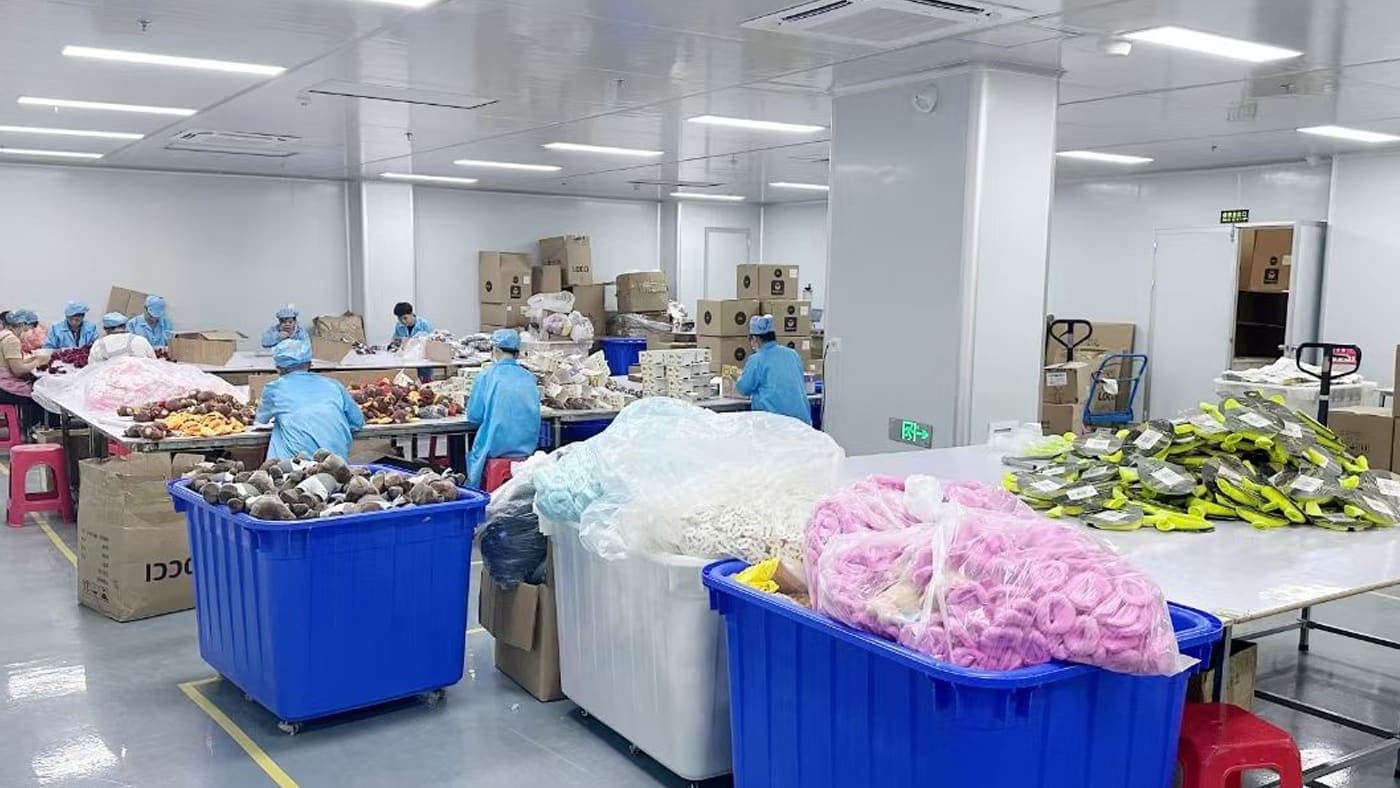
30-second walkthrough of the cut-and-sew, embroidery and QC stations as they look during an active run.
Lead times, by the numbers
Build the schedule, then defend it
30 days is a tight target — but it's not magic. It's a well-defended brief, a single sample revision, a known BOM, and a port that isn't on fire. The single biggest thing you can do as a buyer is to compress your internal sample-approval chain. Every day you take to approve costs the program two days at the back end (because the line has been re-allocated).
Want to scope a 30-day plush program against your real specs? Our OEM service page walks through the full process. Browse current customer cases to see comparable timelines we've shipped against.