Plush Toy MOQ Guide 2026: Real Cost Breakdown & 8-Step Negotiation Playbook
Why custom plush MOQs sit at 100–500 pcs, where unit cost actually goes (BOM share), and how to negotiate lower MOQs without sacrificing quality or compliance.

MOQ is the single number that decides whether your plush toy program is even feasible. Drop the MOQ and the per-unit cost climbs; raise it and the cash-flow risk balloons. This is a B2B-side breakdown of where your money actually goes between 100 and 5,000 units, why most factories quote what they quote, and the eight-step playbook we use to negotiate honestly.
What MOQ is (and what it isn't)
Minimum Order Quantity is not a marketing number — it's the smallest run where the factory's fixed costs (tooling, sampling, line setup, dye lot minimums, QC mobilisation) amortise across enough units that the per-piece price is profitable. For plush specifically, the breakeven is dominated by labour rather than materials, which means MOQ behaves differently from injection-moulded toys. A pattern-cutter, sewer and stuffer team has to be assigned for the duration of the run regardless of whether you order 100 or 1,000 units.
An MOQ of 100 isn't a 'low MOQ' marketing line — it means the factory has decided to absorb part of its fixed-cost amortisation, betting on repeat orders. The Wikipedia primer on MOQ is a useful generalist reference, but plush economics are tighter than the textile average because of three-shift cut-and-sew layout.
How unit cost moves between 100 and 5,000 pcs
These are real 2026 ranges for a 25-cm bear-format plush in 4 colours, with embroidered details and a satin bow. They reflect FOB Shenzhen, before duties or freight. Use them as a sanity-check against any quote you receive.
| MOQ tier | Unit cost (USD) | Tooling amortised | Lead time |
|---|---|---|---|
| 100 pcs | $8.50 – $11.00 | Spread $400 → $4.00 / unit | 30–35 days |
| 300 pcs | $6.20 – $8.50 | Spread $400 → $1.33 / unit | 28–32 days |
| 500 pcs | $5.20 – $7.00 | Spread $400 → $0.80 / unit | 25–30 days |
| 1,000 pcs | $4.50 – $6.00 | Spread $400 → $0.40 / unit | 30–35 days |
| 3,000 pcs | $3.80 – $5.00 | Spread $400 → $0.13 / unit | 35–45 days |
| 5,000 pcs | $3.40 – $4.50 | Spread $400 → $0.08 / unit | 40–50 days |
Industry references for these benchmarks: Statista global toy industry overview, The Toy Association, OEM (Wikipedia).
Where the money actually goes (BOM breakdown)
Most B2B buyers assume the fabric is the dominant cost line. It isn't. For a typical 25-cm plush at 1,000-unit volume, the breakdown looks like this:
| Cost line | Share of unit cost | Notes |
|---|---|---|
| Labour (cut, sew, stuff, finish) | 38–45% | Dominant — fixed by labour rate × minutes per unit |
| Outer fabric (velboa / minky) | 18–22% | Variable with pile depth and Pantone-match |
| PP cotton fill | 8–12% | Cheap per kg but a 25 cm bear takes 100–180 g |
| Accessories (eyes, embroidery thread, satin bow) | 6–10% | Phthalate-tested PVC adds cost |
| Tooling amortised across run | 4–10% | Pattern + first sample + revision rounds |
| QC + AQL inspection | 3–5% | AQL 2.5 visual / 4.0 minor by third party |
| Packaging (polybag + hangtag + master carton) | 5–8% | Retail-ready packaging adds 30–50% |
| Factory margin | 8–14% | What's left after the above |
Tooling and pattern fees: the line you can't escape
Pattern-making, the first physical sample, and 1–3 revision rounds typically cost USD 250–500 for a simple plush silhouette and USD 400–800 for a complex character with multi-piece face construction. Most factories refund this against the bulk PO at MOQ ≥ 500. Asking the factory to skip pattern fees in exchange for an exclusive supply window is a fair trade that aligns incentives — but only if you actually intend to scale.
Material waste and roll-utilisation maths
A 60-inch wide minky roll has a fixed waste pattern when cutting plush body panels. At 100 units the marker layout is inefficient (15–22% scrap); at 1,000 units the marker tightens to 6–9% scrap. That delta is real money — it's roughly USD 0.40 / unit between the two volumes — and it's why factories don't simply 'pass on the savings' below MOQ 500.
Labour amortisation across line setup
A plush line takes 4–6 hours to set up: pattern jigs, embroidery threading, stuffing-machine pressure calibration, QC checkpoints. That setup is fixed regardless of run size. Spread across 100 units it adds USD 1.50–2.00 / piece; across 1,000 units it adds USD 0.15–0.20 / piece. This is the structural reason 100-piece runs always cost more.
The 8-step MOQ negotiation playbook
These are the levers we see real B2B buyers pull successfully — and the ones we wish more buyers used. None require you to have a famous brand.
- 1Bundle SKUsshare materials, fill, accessories
- 2Lock the BOMno fabric switches mid-run
- 3Schedule reorders12-mo forecast = lower MOQ
- 4Pre-pay toolingcredit on the bulk PO
- 5Standard sizingskip custom carton dies
- 6Generic packagingpolybag now, retail later
- 7Accept slot timingfactory off-peak = -8%
- 8Audit annuallyearn 'preferred buyer' rates
MOQ red flags: when 'as low as 50 pcs' is a trap
Below 100 pcs, you should be sceptical of any custom-design plush quote. The four common patterns we see when a buyer brings us a 'too-good' quote from elsewhere:
- ODM rebrand: the factory is selling you a stock pattern with a different label sewn on. You don't own the IP.
- Sub-contracting: the order moves to a home workshop with no QC. Pull-force, burn-rate and lead tests are routinely skipped.
- Unit-cost loaded with hidden fees: the headline number is great until you see the tooling, sample, courier, packaging line items.
- Loose AQL: the factory accepts AQL 6.5 / 10 (vs the 2.5 / 4.0 industry standard), so 6–10% defective rate is 'within spec'.
Reference reading on toy industry pricing dynamics: Alibaba plush manufacturer index, ISO 9001 quality management.
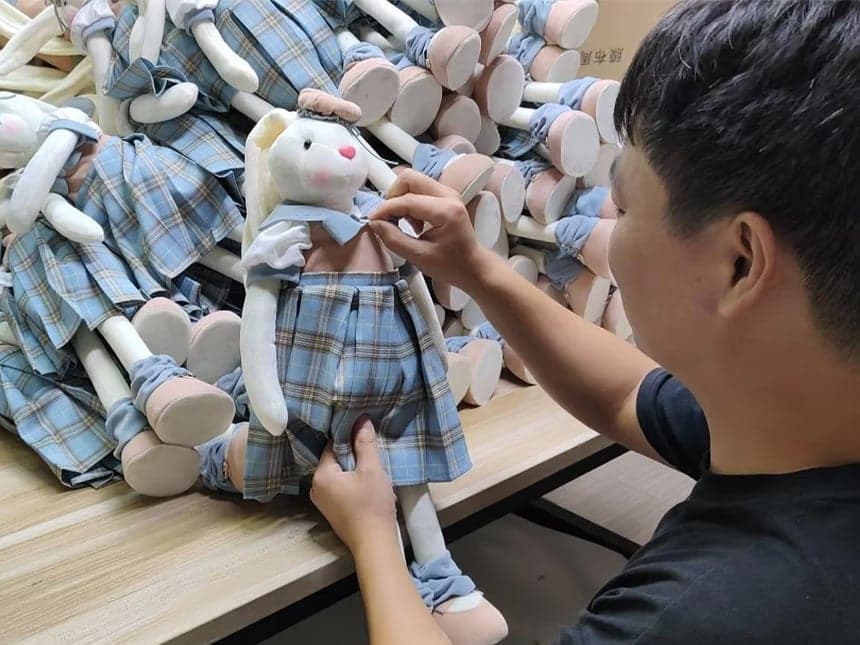
Inside the cut-and-sew lines
30-second walkthrough of where the labour cost — that 38–45% slice — actually gets spent.
MOQ math, by the numbers
MOQ is a forecast, not a price tag
If you treat MOQ as a one-off price negotiation you'll lose every time. Treat it as a 12-month forecast — bundle SKUs, lock BOM, schedule reorders — and you'll see real per-unit drops without sacrificing quality. StarDream Toys ships at MOQ 100 because we run repeat business with the same buyers; the second order is where both sides win.
When you're ready to scope numbers against a real BOM, our OEM service page walks through the costing model. Browse current customer cases to see comparable SKUs already on the floor.