Plush Toy Safety Standards 2026: EN 71, ASTM F963 & CPSIA Compliance Guide
What ASTM F963, EN 71 and CPSIA actually test, what the lab fees cost, and the 4 compliance failures we see most often on plush toys. Factory-side guide for B2B importers.

If you're sourcing custom plush toys for a US, EU or Canadian market, three letters decide whether your container clears customs or sits at the port: ASTM, EN71, CPSIA. This is a practical, factory-side guide to what each standard actually tests, what it costs, and the eight tests we see B2B buyers fail most often.
Why plush toys live under two regulatory worlds
There is no single global toy safety standard. Manufacturers serving multiple markets have to satisfy parallel — and sometimes conflicting — regimes. The two that matter for 90% of plush export volume are the United States (CPSIA + ASTM F963) and the European Union (EN 71 + REACH). Canada has its own Canada Consumer Product Safety Act (Toys Regulations); Australia adopts AS/NZS ISO 8124; Japan applies the ST 2016 voluntary mark. Whichever market you ship to, the principle is the same: the importer of record carries the liability, not the factory.
Both regimes converged on the same risk model — choke hazards, flammability, chemical migration, mechanical failure — but their pass/fail thresholds, sampling plans and labelling requirements differ enough that one lab report rarely satisfies both markets. The ISO 8124 family of standards is closest to a global baseline, but the US still demands ASTM F963 testing on top of any ISO equivalent, and the EU requires EN 71 specifically.
ASTM F963 vs EN 71: what each standard actually checks
Below is the side-by-side that matters most for plush. Mechanical, flammability and chemical limits are summarised in plain English; the cell entries are the values your QA lab will report against.
| Test category | ASTM F963 (US) | EN 71 (EU) |
|---|---|---|
| Lead in substrate | ≤ 90 ppm (CPSIA limit) | EN 71-3: ≤ 160 ppm migration |
| Phthalates (8 named) | ≤ 0.1% each (CPSIA) | REACH Annex XVII Entry 51/52 |
| Burn rate (textile) | ≤ 0.1 inch / sec (16 CFR 1500.44) | EN 71-2: time-to-flame + spread |
| Small parts | Use-and-abuse + small-parts cylinder | EN 71-1 §5: dimensional + tensile |
| Eye / nose pull-force | ≥ 15 lbf (≥ 6.7 kgf) | EN 71-1 §8: ≥ 90 N for ≤ 36 months |
| Heavy metals (19) | Lead + cadmium scope only | EN 71-3 covers 19 elements |
| Flammability of stuffing | Class 1 textile per CFR | EN 71-2 §5.4 ignition test |
| Tracking label | Mandatory (CPSIA §103) | CE mark + EN 71 reference |
Authoritative references for the table values: CPSC.gov toy-safety overview, ASTM F963-23 specification, EN 71 (Wikipedia summary), CPSIA (Wikipedia summary).
The 6-stage compliance flow we run for every new plush SKU
This is the path a new design takes from pattern-table to compliant export carton. Each stage gates the next — a fail at stage 3 stops the entire line until corrected.
- 1Material BOM lockfabric / fill / dyes / accessories certified
- 2Pre-shipment lab bookingSGS / Bureau Veritas / Intertek
- 3Mechanical & flammabilityASTM use-and-abuse + EN 71-2
- 4Chemical migrationEN 71-3, CPSIA lead, phthalates, REACH
- 5Tracking label + CPCCPSIA §103 + EU CE / DoC
- 6Carton + AQL inspectionAQL 2.5 visual / 4.0 minor
Materials safety: fabric, fill, dyes, embroidery thread
The single most common failure we see is a fabric or fill change made by the buyer's own purchasing team after the lab report was issued. If the BOM changes, the report is void. These are the four material categories that need an OEKO-TEX Standard 100 (or equivalent) certificate on file before mass production:
- Outer fabric (super-soft velboa, short-pile minky, recycled PET fleece) — must clear AZO dye, formaldehyde and pH limits.
- Polyester fibrefill (PP cotton) — virgin grade preferred; recycled fill needs additional VOC and odour testing.
- Embroidery thread + appliqué felt — colour-fast bleeding test in saliva and sweat simulant.
- Plastic safety eyes / noses — washer-locked, pull-force tested at the assembled-toy stage.
Reference: OEKO-TEX Standard 100 is the de-facto material baseline most plush factories work to.
Mechanical hazards: small parts, eyes, fasteners, stitching
Plush toys for under-3s (months 0-36) are the strictest tier. Anything that fits inside the small-parts cylinder is a fail. ASTM and EN 71 both run a use-and-abuse simulation: torque, tension, drop, soak, bite. The pull-force on safety eyes is the second-most-common failure mode after flammability — we lock washers behind every eye, and we don't accept glue-only attachment on under-3 SKUs.
Chemical limits: lead, phthalates, AZO dyes, formaldehyde
Lead is the marquee CPSIA limit (90 ppm in the substrate) but in practice, plush toys rarely fail on lead; they fail on phthalates from PVC accessories (zipper pulls, plastic noses) and on AZO dyes in low-grade fabric. ECHA REACH Annex XVII enumerates the EU chemical restrictions; for the US, CPSIA Section 108 is the phthalate reference.
Pre-shipment compliance checklist (12 items)
Print this and stick it on the QC office wall. We don't release a container without all 12 boxes ticked.
- Final BOM matches the lab-tested BOM (fabric lot, fill batch, accessory SKUs).
- ASTM F963 + 16 CFR 1500.44 burn-rate test report on file (US-bound).
- EN 71-1 / -2 / -3 + REACH SVHC report on file (EU-bound).
- Children's Product Certificate (CPC) signed and travelling with the shipment.
- Tracking label (CPSIA §103) printed on the sewn-in label, not just hangtag.
- Choking-hazard warning on retail packaging (US: 3+ years).
- CE mark + responsible-importer address (EU only).
- AQL 2.5 visual / 4.0 minor inspection passed by third party (we use SGS).
- Carton drop test (1.2 m, 6 sides) — sample once per 1,000 cartons.
- Polybag suffocation warning printed in destination language.
- Material safety data sheet (MSDS) for each fabric lot.
- Photograph of the finished product, attached to the lab report cover page.
Lab partners we co-test with: SGS, Bureau Veritas, Intertek.
The 4 testing failures we see most often
Failure rates we observe across 200+ buyers: (1) Burn rate exceeded due to a fabric switch — 38% of failures. (2) Phthalate spike from a PVC zipper pull or eye glue — 24%. (3) Eye pull-force below 15 lbf because washer was skipped — 19%. (4) Tracking label missing or printed only on hangtag — 12%. The remaining 7% are split across choke-hazard cylinder fails, lead in metallic embroidery thread, and AZO dye in red / yellow accent fabric.
Inside our compliance lab
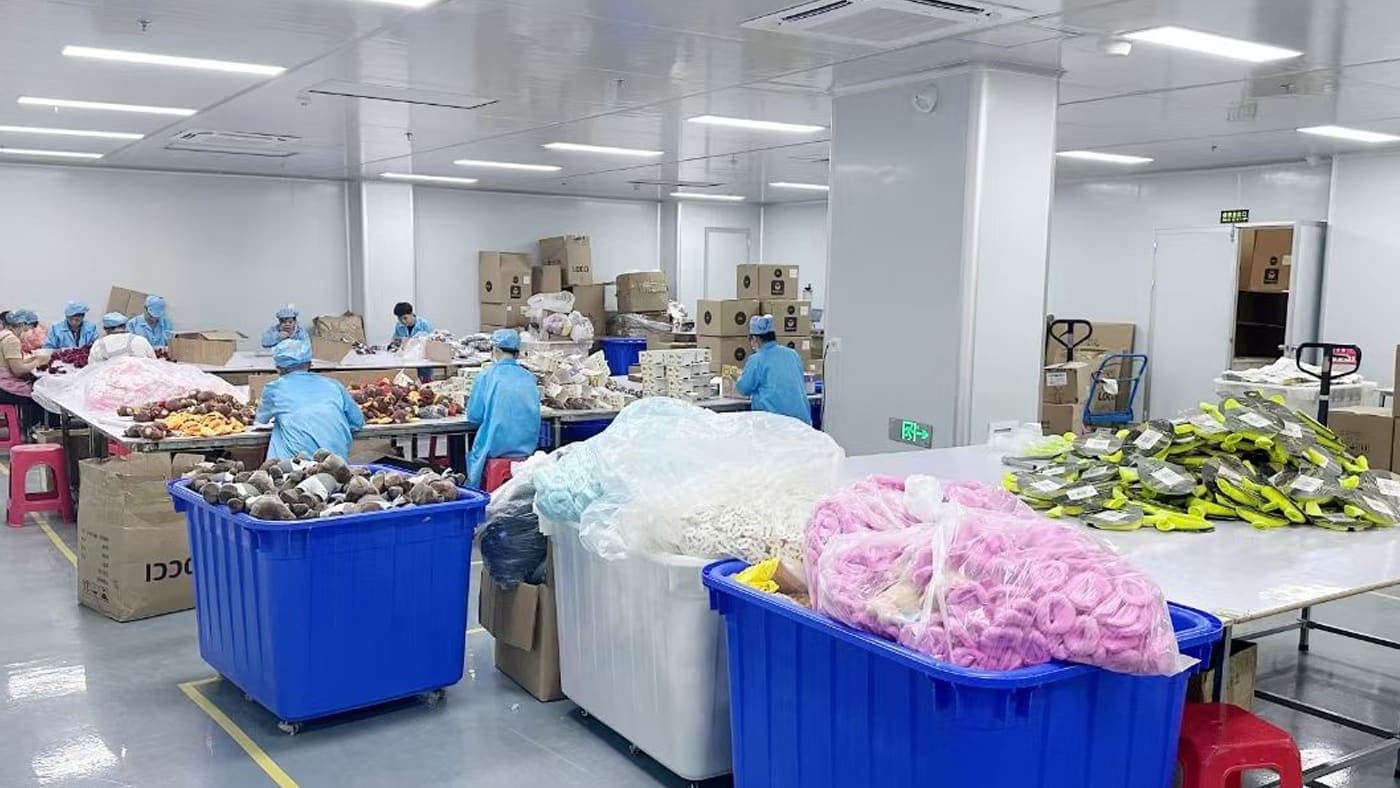
This is a 30-second walkthrough of where we run pull-force, burn-rate and AQL inspections before a container is sealed.
Compliance, by the numbers
Make compliance a vendor question, not an importer surprise
The single highest-leverage thing a B2B buyer can do is to require a fresh lab report on every BOM change, and to ask the factory whether they self-fund the test or pass it through. At StarDream Toys we self-fund first-article ASTM and EN71 tests for every new OEM design — it's cheaper than catching a problem at the destination port.
If you're scoping a new program, our OEM service page walks through pattern, sample and bulk lead times, and the customer cases section shows the SKUs we currently have on the floor.